Proactive Maintenance in Action: How Catching a Failing Air-End Saved a Texas Facility From an Unplanned Shutdown
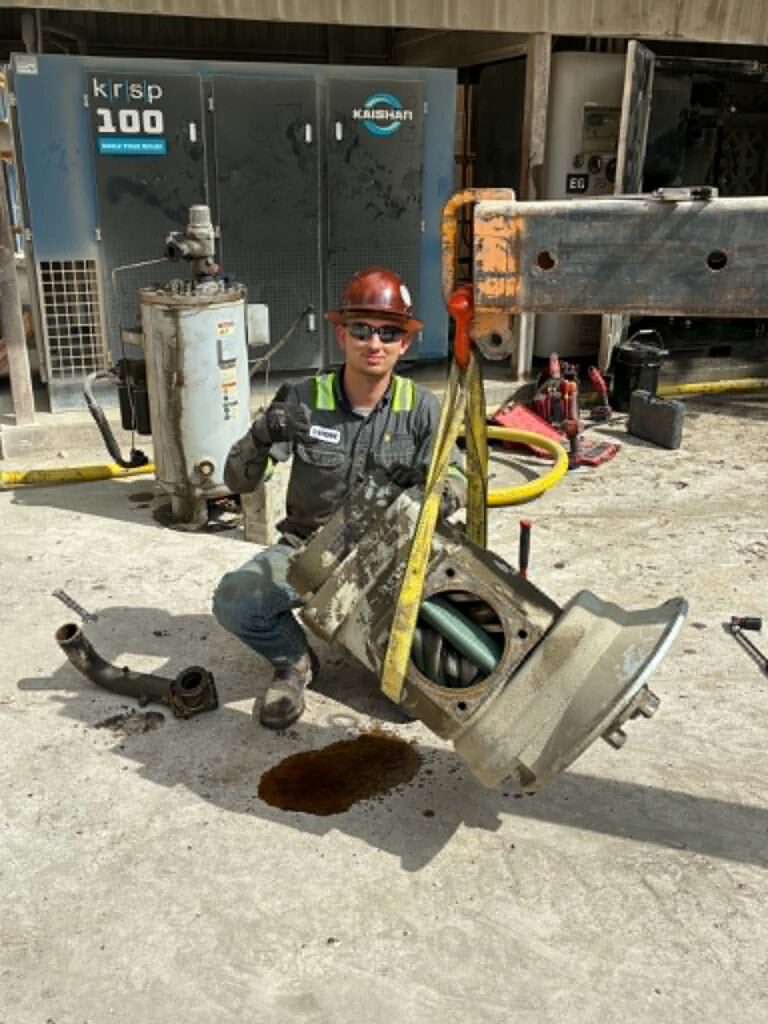
The photo on this post tells a story, but not the one you might assume at first glance. This is not a breakdown. This is not an emergency call. This is what happens when proactive maintenance does exactly what it is supposed to do.
What You Are Looking At
Our technician is on site at a customer facility with an ELGi air-end that has been removed from the compressor. The housing is open, the rotors are exposed, and the unit is strapped for transport. Behind it, you can see the rest of the operation still running. That last detail matters, because the point of this story is that production never stopped.
How We Got Here
During a routine service visit, our team identified early indicators that this air-end was beginning to fail. The signs were there in the data: elevated discharge temperatures, a gradual increase in amp draw, and subtle changes in vibration and noise that an experienced technician recognizes before most monitoring systems flag them.
This is the critical moment in the life of any compressor, and how you handle it determines whether you end up with a controlled repair or an emergency shutdown.
A failing air-end that is not caught in time will eventually seize. When that happens, the compressor stops instantly. Production goes down. And the air-end, which might have been rebuildable if addressed early, may now be damaged beyond economical repair. The rotor surfaces score, the bearings weld to the shafts, and the housing bores get gouged. What would have been a rebuild becomes a full replacement at significantly higher cost, plus however many hours or days of lost production it takes to source and install the new unit.
That is not what happened here.
The Customer Had Options
Because we caught the failure early, the customer had time to make a decision instead of being forced into one. No panic. No emergency freight charges. No scrambling for a rental. Just a clear-eyed conversation about the best path forward.
The customer chose to purchase a new air-end. We had it on site and installed the next day. The compressor was back online with zero hours of unplanned downtime. The customer’s operation never missed a beat.
That kind of turnaround is only possible when two conditions are met. First, the problem has to be identified before it becomes a crisis, which requires regular, competent service by technicians who know what to look for. Second, the parts and the people have to be available to respond immediately once the decision is made. Having a distributor who keeps inventory and has techs ready to deploy is the difference between a next-day swap and a three-week wait.
The Rebuild: Planning for Next Time
The story does not end with the new air-end installation. The original air-end, the one in the photo, is now in our rebuild process. A full air-end rebuild is not a quick turnaround. It involves complete disassembly, dimensional inspection of the rotors and housing bores, replacement of all bearings, seals, and gaskets, precision machining where needed, and reassembly to OEM tolerances. That process takes a minimum of six weeks, and it cannot be rushed without compromising quality.
But here is the smart part. Because the customer is not waiting on this rebuild to get back into production, the timeline does not matter operationally. The compressor is already running with the new air-end. When the rebuild is complete, the refurbished air-end goes onto the customer’s inventory shelf as a dedicated backup.
That means the next time this air-end reaches the end of its service life, whether that is in three years or five years or eight years, the customer already has a rebuilt spare sitting on the shelf ready to install. The swap takes hours instead of weeks. There is no emergency, no downtime, and no scramble for parts.
That is what a real maintenance strategy looks like. It is not just fixing problems. It is building a system where the next problem is already solved before it happens.
Why This Matters for Your Facility
This is not a one-off story. This is how we approach every customer relationship at IOS. Proactive service means more than just showing up on schedule to change oil and filters. It means our technicians are trained to evaluate the condition of critical components at every visit, identify trends that indicate developing problems, and communicate those findings to the customer in time to make smart decisions.
The alternative is reactive maintenance, which means waiting for something to break and then dealing with the consequences. Reactive maintenance always costs more. The repair itself is more expensive because the damage is worse. The downtime is longer because the failure was unplanned. The stress level is higher because everyone is scrambling instead of executing a plan.
Every facility has the choice between those two approaches. The photo on this post shows what the proactive side looks like in practice.
If your facility depends on compressed air and you do not have a service partner who is catching problems before they become emergencies, it is worth having that conversation. Give us a call and we will walk through your equipment, your maintenance history, and your risk exposure. The best time to plan for a failure is when everything is still running.