Nitrogen Generation Technology: Membrane vs PSA and How to Choose the Right One
If your facility has already evaluated the economics of on-site nitrogen generation versus delivered nitrogen, and the numbers favor generating your own, the next decision is which technology to install. There are two primary options: membrane separation and pressure swing adsorption (PSA). They both produce nitrogen from compressed air, but they do it differently, they excel in different purity ranges, and choosing the wrong one will cost you either in wasted energy or in nitrogen that does not meet your process requirements.
How Membrane Nitrogen Generation Works
Membrane generators use bundles of hollow polymer fibers to separate nitrogen from the other components of compressed air. When compressed air enters the fiber bundle, gases permeate through the membrane walls at different rates. Oxygen, water vapor, and carbon dioxide pass through faster than nitrogen. The gas that exits the end of the fiber bundle is nitrogen-enriched air, with the rejected gases vented to atmosphere.
The technology is elegant in its simplicity. There are no moving parts in the separation module itself. No valves cycling, no media to replace, no regeneration cycles. The only active component is the air compressor feeding the system. Maintenance requirements are minimal, limited primarily to pre-filtration elements that protect the membranes from oil and particulate contamination.
Membrane systems are compact, quiet, and fast to install. For many facilities, they can be up and running the same day they arrive.
Where Membranes Excel
Membrane generators are most efficient and cost-effective when the application requires nitrogen purity in the 95 to 99.5% range. In this window, the ratio of nitrogen produced to compressed air consumed is favorable, and the cost per unit of nitrogen is competitive with or better than delivered gas.
Applications that commonly fall in this purity range include tire inflation for commercial fleets and aviation, fire suppression system blanketing, general inerting of tanks and vessels where moderate oxygen reduction is sufficient, corrosion prevention in closed systems, and some blanketing applications in oil and gas.
Where Membranes Struggle
The physics of membrane separation create a steep efficiency curve above 99.5% purity. To push nitrogen purity higher, you have to slow the air flow through the membranes or reject a larger fraction of the inlet air as waste. Either way, the compressed air consumption per unit of nitrogen produced increases dramatically. A membrane system producing 99.9% nitrogen may consume two to three times the compressed air that the same system would consume producing 98% nitrogen.
This does not mean membrane systems cannot produce high-purity nitrogen. They can. It means the energy cost of doing so makes them uneconomical compared to PSA at those purity levels.
How PSA Nitrogen Generation Works
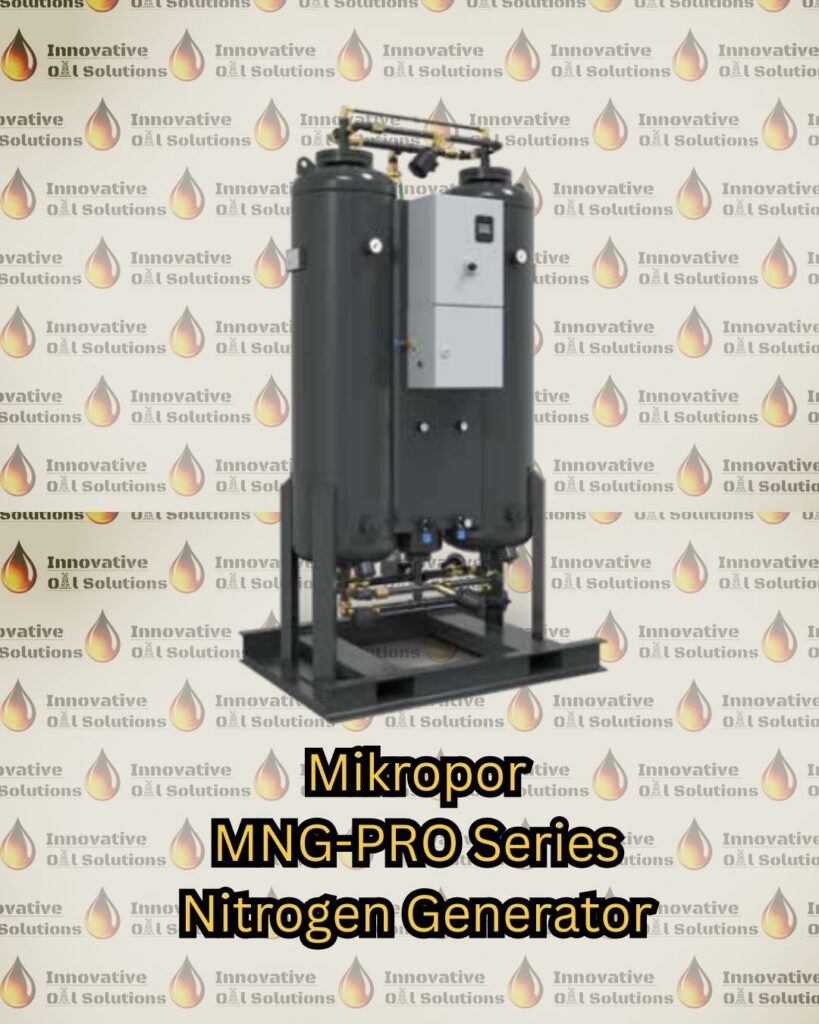
PSA generators use a different separation mechanism. Compressed air flows into a vessel filled with carbon molecular sieve (CMS) media. Under pressure, the CMS adsorbs oxygen molecules while allowing nitrogen molecules to pass through. The result is a stream of high-purity nitrogen exiting the vessel.
The system uses two vessels. While one vessel is adsorbing oxygen and producing nitrogen, the other is regenerating by depressurizing and venting the adsorbed oxygen to atmosphere. The vessels alternate on a timed cycle, producing a continuous flow of nitrogen.
PSA systems are more complex than membranes. They involve cycling valves, pressure vessels, control systems, and the CMS media itself, which has a finite service life and eventually needs replacement. Maintenance requirements are higher, and the physical footprint is larger. But the performance at high purity levels is substantially better.
Where PSA Excels
PSA generators are the right choice when the application requires nitrogen purity at or above 99.5%, and particularly at 99.9% and higher. At these levels, PSA produces nitrogen with significantly less compressed air consumption per unit of output compared to membrane systems.
Applications that typically require PSA-grade purity include food and beverage modified atmosphere packaging (MAP), where residual oxygen must be minimized to extend shelf life, pharmaceutical manufacturing under regulatory requirements for inert atmospheres, laser cutting assist gas, where nitrogen purity directly affects cut quality and edge finish, electronics and semiconductor manufacturing, where trace oxygen causes oxidation defects, and chemical blanketing and reactor purging, where process chemistry is sensitive to residual oxygen.
The Compressed Air Supply Matters for Both
Neither technology produces nitrogen from nothing. Both require a supply of clean, dry compressed air at adequate pressure and flow rate. The quality of that supply directly affects the performance and service life of the generator.
Membrane systems are particularly sensitive to oil contamination. Lubricant carryover from oil-injected compressors can coat the membrane fibers, permanently reducing their permeability and output capacity. Multi-stage coalescing filtration and activated carbon filtration upstream of the generator are essential.
PSA systems are sensitive to moisture and particulate. Wet air degrades the adsorption capacity of the carbon molecular sieve, and particulate contamination can block the pore structure. Adequate air drying, typically to a pressure dew point of 35 to 40 degrees F or lower, and particulate filtration are required.
In both cases, the compressor must be sized to handle the additional air demand that the nitrogen generator represents on top of existing plant air requirements. An undersized compressor will struggle to maintain pressure for both the generator and the plant, resulting in reduced nitrogen output and pressure instability across the facility.
How to Choose
The decision framework is straightforward. Start with the nitrogen purity your process requires. Not what someone estimated or what a previous vendor suggested, but what the actual application specification calls for.
If the required purity is 99.5% or below, membrane is likely the most cost-effective choice. Lower maintenance, simpler installation, smaller footprint, and competitive operating cost in that purity range.
If the required purity is above 99.5%, PSA will almost certainly deliver a lower cost per unit of nitrogen produced. The higher equipment and maintenance cost is more than offset by the energy savings at elevated purity levels.
If you are uncertain about your purity requirement, it is worth testing. Some applications that have historically specified 99.9% nitrogen may perform acceptably at 99% or even 97%, which opens the door to the simpler and less expensive membrane option.
Either way, the compressed air system feeding the generator needs to be evaluated as part of the project. A nitrogen generator is only as good as the air supply behind it.
That is something we help Texas facilities design and install. If you are evaluating on-site nitrogen generation, give us a call and we will help you match the right technology to your actual requirements.