Moisture in Your Air Lines Is Costing You More Than You Think
Most plant managers check on their compressor religiously — oil changes, filter swaps, bearing temps, the whole routine. But there is another component in the compressed air system that quietly causes more damage than almost anything else when it goes wrong: the air dryer.
Here is the thing about compressed air — when you compress ambient air, you are also concentrating the moisture that was already in it. A 100 CFM compressor running in a Texas summer can push several gallons of liquid water through your system per hour if there is nothing downstream to pull it out. That moisture has to go somewhere, and it usually ends up in your tools, your controls, your product, and your pipes.
WHAT MOISTURE DOES TO YOUR SYSTEM
Liquid water in compressed air does not just cause rust. It is behind more failures than most people account for: corroded pipe internals, waterlogged pneumatic actuators, fouled solenoid valves, and in food or pharmaceutical environments, outright contamination. On oil-flooded compressors, moisture mixes with the lubricant and causes the oil to emulsify — that milky sludge on your separator element is moisture at work.
REFRIGERATED VS. DESICCANT — WHICH DO YOU NEED?
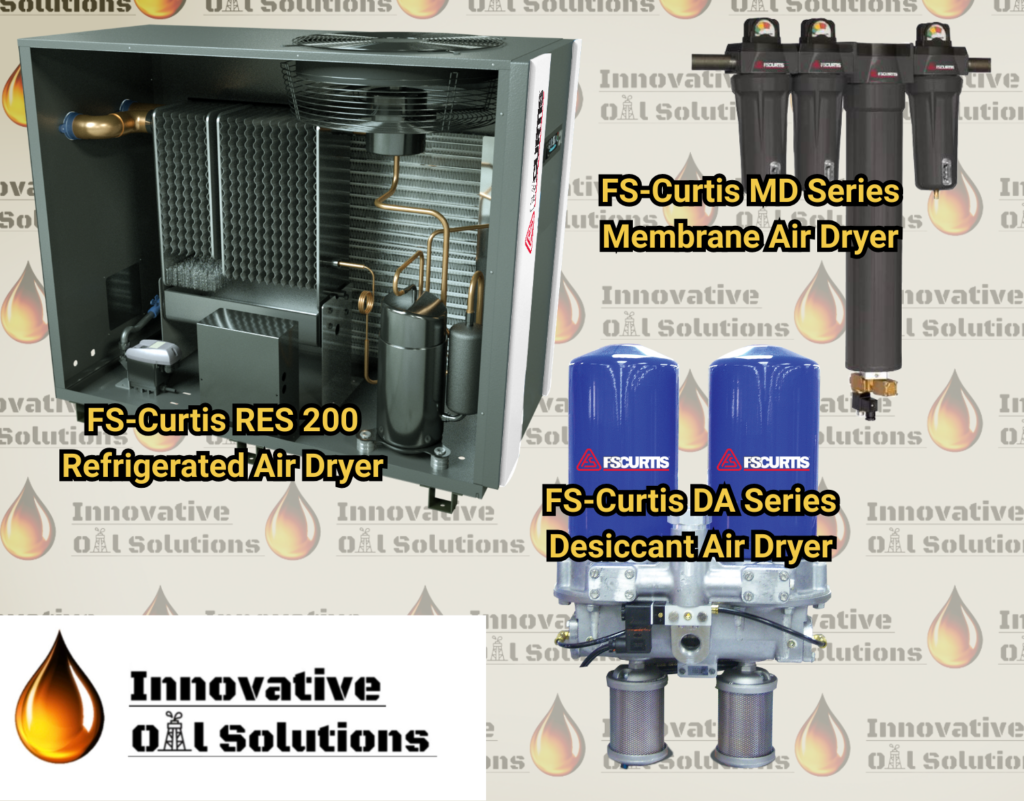
Refrigerated dryers are the workhorses. They cool the air to around 35–50°F pressure dew point, causing moisture to condense and drain out. They are energy-efficient, low-maintenance, and adequate for general shop air, pneumatic tools, and most manufacturing processes.
Desiccant dryers go much further. They pull moisture down to dew points as low as -40°F or even -100°F using adsorptive media. These are used when air quality is critical — instrument air for process controls, air in contact with sensitive products, or applications where any moisture at all causes problems. They cost more to run, but when you need them, nothing else does the job.
THE MISTAKE WE SEE MOST OFTEN
Undersized dryers. A shop buys a new 100 HP compressor, keeps the old dryer they have had for 15 years, and wonders why they still have moisture problems. Dryers are rated at specific inlet temperature and ambient conditions — conditions that are very different from a Texas summer afternoon. A dryer that looks right on paper can be completely overwhelmed when your inlet air temp is 110°F and your ambient is 95°F.
The second most common mistake: ignoring the automatic drain. When it fails, the dryer fills with condensate and routes it right back into the air stream. A quick check is one of the easiest things to add to a PM schedule.
If your lines are producing corrosion, actuator issues, or air quality complaints — the dryer is worth a hard look before you point the finger at anything else.